New research: 1,000 enterprise leaders on the AI decision-confidence gap.
Less than half of your data informs a decision. You’re paying for all of it.
Every year, enterprises spend more on data. They buy new platforms, build bigger warehouses, add analytics tools, and hire larger data teams. Each investment is approved on the same assumption: better data leads to better decisions.
So here’s a question worth raising in your next budget review: how much of that data actually informs a decision?
The 49% problem
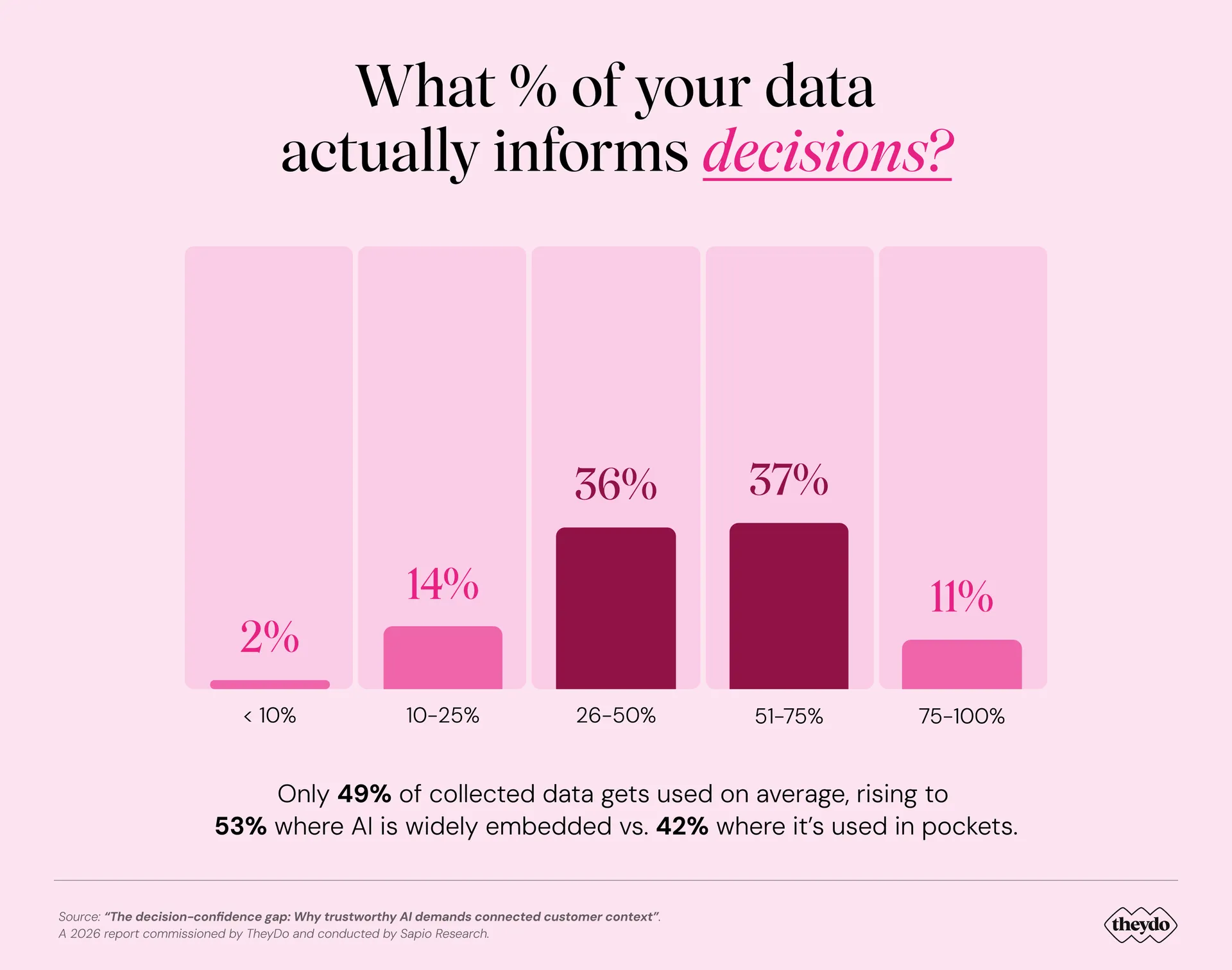
For The Decision-Confidence Gap report, Sapio Research surveyed 1,000 business decision-makers with direct influence over budget allocation at organizations with more than 1,000 employees. One question asked: “What percentage of the data and insights your organization collects actually gets used to inform a decision?”
On average, the answer was 49%.
Few organizations come close to using it all. Only 11% use more than three-quarters of what they collect. Most use between a quarter and three-quarters. The unused data still costs money to collect, store, and secure. It just never shapes a decision.
If you sign off on data budgets, this matters. A lot. The costs are clear: licenses, infrastructure, headcount, and vendor contracts. The return is harder to pin down. How much does that investment help the business decide what to do next? When less than half the data collected informs a decision, there’s a real question about whether most of that spend is paying off.
Bill Staikos, an independent CX advisor at Be Customer Led, puts it bluntly: “If more than half of insights never change a decision or action, leaders should be asking a much harder question: Why are we still paying to collect it?”
For many organizations, the honest answer is that nobody has asked.
Why so much data goes unused
In most enterprises, data sits in separate systems owned by separate teams: finance, product, operations, service, and marketing. Each system answers the questions it was built to answer. Few of them are connected in a way that shows how a change in one area affects another.
So when a decision needs to be made, the relevant information often exists, but not in one place and not in a form anyone can act on quickly. Pulling it together takes analysts, meetings, and time. Often, the decision is made before that work is done, based on whatever evidence is easiest to obtain. The rest stays in storage.
Different sources also tend to disagree. In the same research, 77% of decision-makers said their dashboards, CRM data and customer feedback tell different stories at least some of the time. (We looked at what that does to decision-making in The more-data myth.) When sources conflict, it’s often easier to rely on the one you trust most and set the others aside.
The result is a pattern many data and finance leaders will recognize. Investment keeps flowing into collecting data, while far less goes into the infrastructure that makes it usable when a decision is being made.
Does AI help teams use more of their data?
In organizations where AI is widely embedded across teams, an average of 53% of collected data is used to inform decisions. Where AI is used only in isolated pockets, that figure drops to 42%.
That doesn’t prove that AI leads to better data use. Organizations that embed AI widely may also have done more to connect their data in the first place. The figures show a link between wider AI adoption and greater data use, but they don’t explain what drives it.
And even at 53%, nearly half of collected data still goes unused. AI needs access to relevant information to produce useful recommendations. If important data remains out of reach, those recommendations may miss part of the picture.
What leaders need to make better decisions
When asked what would most improve their decisions, respondents pointed to greater confidence in AI-generated insights or more context around the data already in their systems.
That’s worth noting for anyone planning next year’s data budget. Before investing in more data, ask two questions. Can teams connect the information already in their systems? And can the people making decisions find it, and understand what it means, in time to use it?
Put more of your data to work
The Decision-Confidence Gap report outlines four shifts organizations can make to get more out of the data they already collect. The first is to bring relevant data together at the point of decision, rather than leaving it scattered across reports, teams, and systems. The second is to make AI recommendations traceable, so people can see the evidence behind them before anyone acts. The other two focus on measuring outcomes beyond individual teams and clarifying who owns the connections between them.
None of these changes requires starting over. Most large organizations already have much of what they need: the data, the tools, and the analytical talent. What’s usually missing is the connective layer that brings them together.
Which brings us back to the budget review. Before approving another data investment, ask: How much of what we already collect actually informs a decision, and what would help us use more of it?
The Decision-Confidence Gap report can help you answer that. It draws on findings from 1,000 business decision-makers and lays out four shifts to help organizations put more of their data to work.
See where your data stops short of a decision, and what it takes to close the gap.